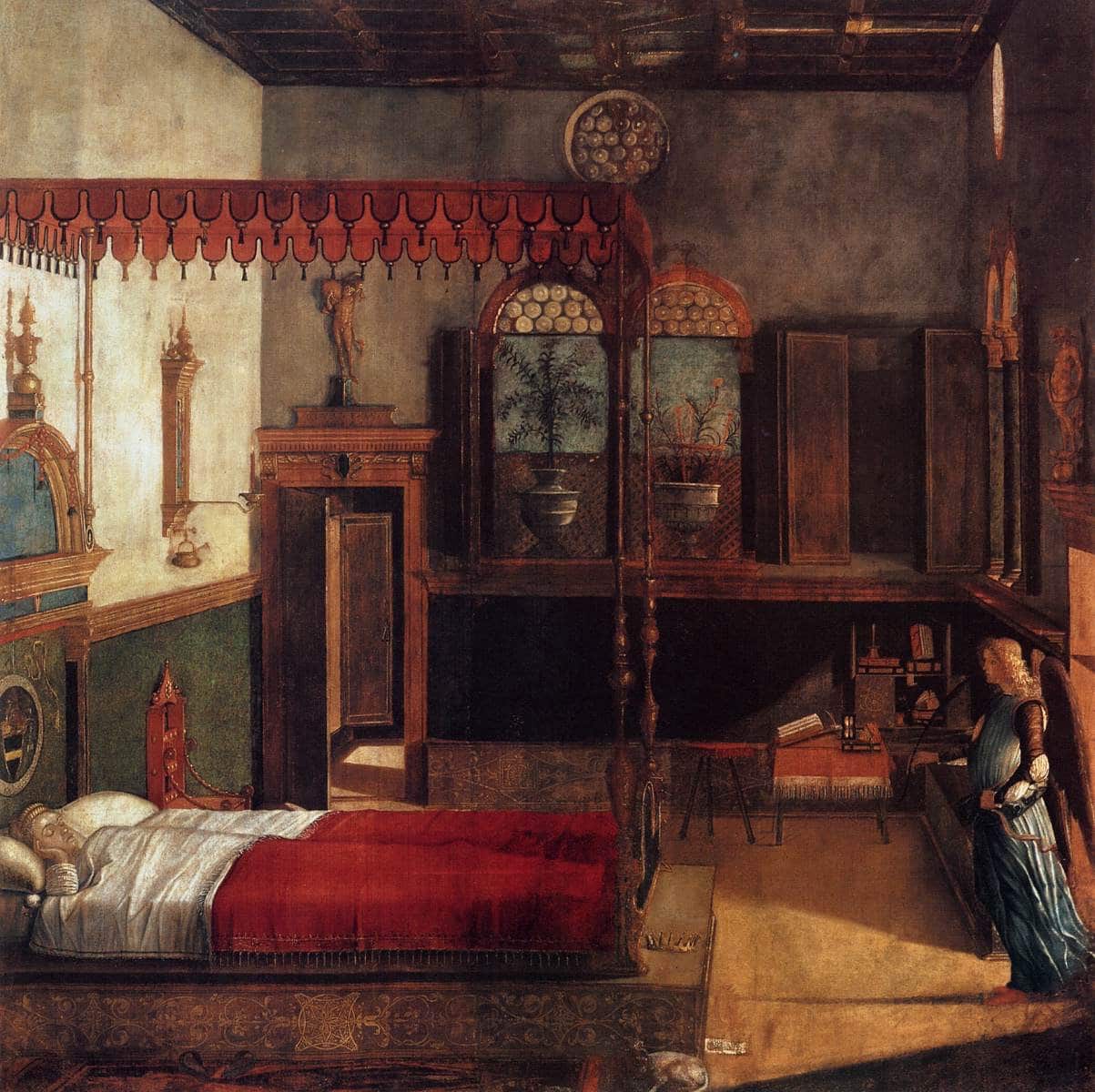
I’m a creature of habit so as usual the other morning I wandered down to the Accademia gallery, flashed my friend’s card (€50 a year for unlimited access — given a single visit costs €20 on its own, that’s a bargain) and asked in a hopeful voice, ‘Any chance I can see Ursula?’
The answer as usual was a shrug that would have done Colin Farrell justice.
Sala XXI at the Accademia, which holds this extraordinary cycle of paintings, has been closed since building works began in November 2022, part of a larger renovation of the museum’s first floor. The one thing that has periodically appeared is a single canvas, the Dream of Saint Ursula, shown on its own, though seeing one work in isolation misses the entire point of the cycle, which is nine scenes meant to be read together as a single unfolding story. A kind of Renaissance Technicolor IMAX if you like.
This isn’t even the first time in recent years these masterpieces have vanished behind closed doors. The room closed in August 2016 for restoration of the remaining canvases (the Arrival in Cologne had already had conservation work in 2013; the Apotheosis of Saint Ursula and the other seven followed, Save Venice funding the campaign, with diagnostics going back to 2010). From February 2018 the museum ran it as an open restoration lab — guided visits let people watch the conservators at work — but as a place to see the whole cycle together, the room stayed closed to ordinary visitors until it reopened on 8 June 2019.
And that reopening window was smaller than it looks on paper. Italy’s museums shut nationally from 8 March 2020 as Covid arrived, reopened only patchily through that summer, closed again for a second wave from 5 November to 3 December 2020, and Venice’s civic museums stayed dark into 2021. International arrivals were then throttled by quarantine and testing rules for much of 2021 and into 2022. So of the roughly three and a half years the cycle was nominally on view between June 2019 and the November 2022 closure, a good chunk fell inside lockdowns or travel restrictions that would have kept most visitors away regardless. Add it up and these nine masterpieces — one of the supreme achievements of Venetian narrative painting — have been pretty much unseeable for something like six of the last ten years.
Carpaccio was a storyteller, a great narrative city painter — less interested in altarpiece grandeur than in telling a story across a room full of canvases, packed with the costumes, gondolas, and street life of the time dressed up as somewhere else (Cologne, Brittany, Jerusalem). His reputation rests on his teleri — the large narrative cycles painted for Venice’s scuole, the lay confraternities that commissioned art for their meeting halls.
Ursula is a great and annoying loss. It would be wonderful if someone could put a rough date on when she might resurface. Till then, if you want your Carpaccio fix, there are plenty of other paintings to be found. I highly recommend a touch of this wonderful artist for any Venice visit.
Principal works and where to see them
Open a route to all four venues in Google Maps
- Gallerie dell’Accademia (Dorsoduro) — his masterpiece, the nine-canvas Stories of Saint Ursula cycle (1490–95), painted for the Scuola di Sant’Orsola. Also holds other Carpaccio works from the Accademia’s own collection. But as I said above, the Ursula cycle is pretty much out of view right now.
- Scuola Dalmata dei Santi Giorgio e Trifone (the Scuola di San Giorgio degli Schiavoni, Castello) — his other great surviving cycle, and the one Ruskin loved best. Painted 1502–07 for the confraternity of Venice’s Dalmatian community, still hanging in the small ground-floor hall built for them — nothing dispersed to a museum, nothing reordered by a later curator. Nine paintings in all: scenes from the lives of the scuola’s patron saints George, Tryphon and Jerome, plus two episodes from the life of Christ. Carpaccio moves from the theatrical violence of St George and the Dragon, spears and bones scattered across an open plain, to the hushed, cluttered calm of the Vision of St Augustine, the saint at his desk with his little white dog, caught mid-sentence by a shaft of light announcing Jerome’s death. St Jerome himself gets two panels — leading a tamed lion into a monastery, then lying in state as monks pay their respects — and there’s Tryphon quietly exorcising a basilisk-demon from the daughter of the Roman emperor Gordian. It’s a compact, dim room in a location that’s easy to miss. The works appear in a good number of books on Venice, my own Carnival for the Dead among them.
- Museo Correr (Piazza San Marco) — holds Two Venetian Ladies (long, wrongly, called “The Courtesans”), one of his most famous single panels. More on that later.
- Ca’ d’Oro / Galleria Franchetti (Cannaregio) — the Annunciation and Death of the Virgin (1504), plus panels from his Stories of the Virgin.


Where to find them
- Gallerie dell’Accademia — Dorsoduro
- Scuola Dalmata dei Santi Giorgio e Trifone — Castello
- Museo Correr — Piazza San Marco
- Ca’ d’Oro / Galleria Franchetti — Cannaregio


Leave a Reply