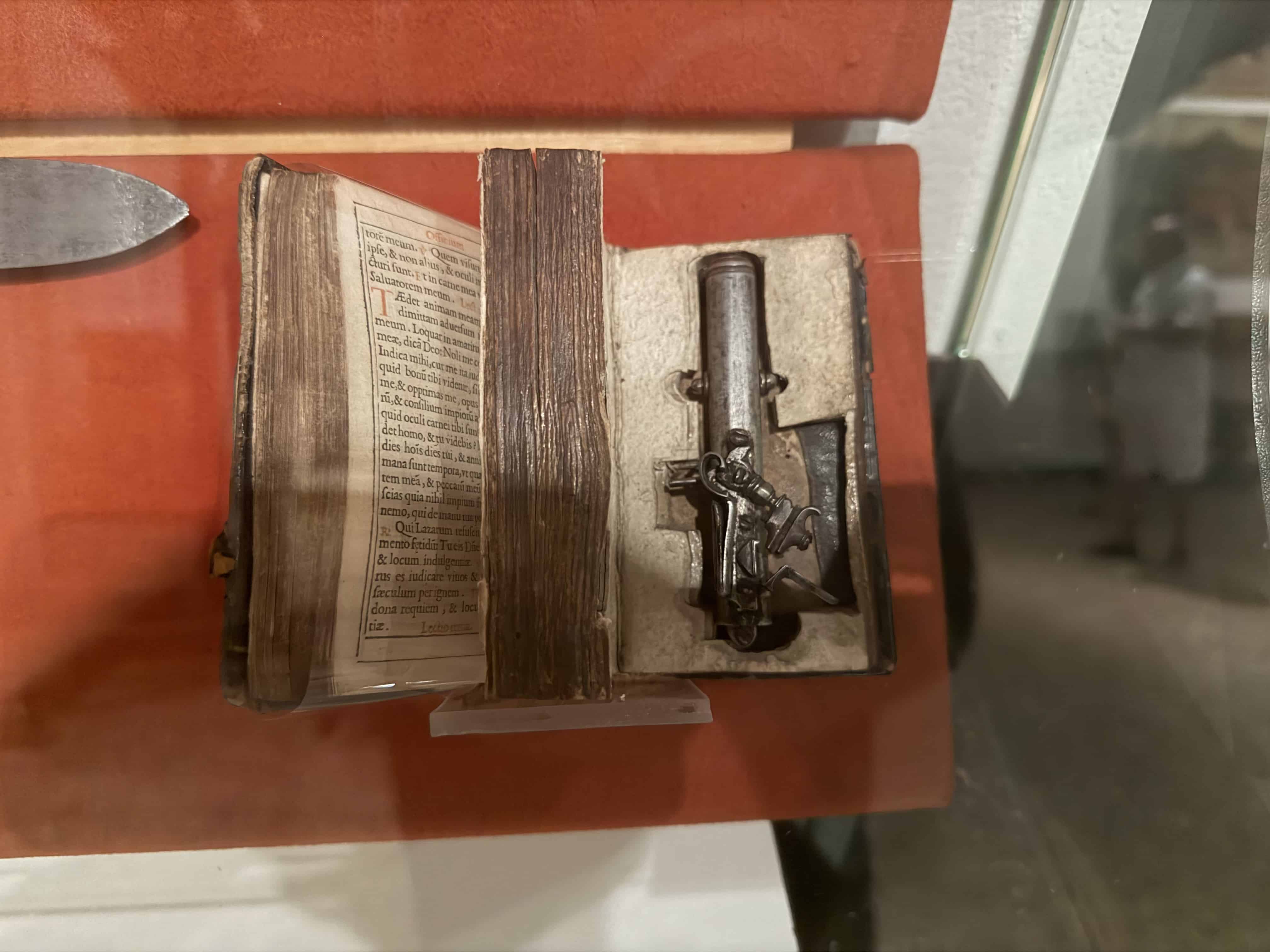
In a glass case in Venice there’s a small, dark prayer book with a big and deadly secret. Open it and the pages are real enough: Latin, red rubrics, what looks to me like the Office of the Dead. Turn to the other half and the paper has been hollowed out to cradle a tiny pistol. It belonged to Francesco Morosini, Doge of Venice, and the story goes that the owner could fire it with the book still closed, by pulling the silk bookmark. (I’d treat that detail as museum-shop folklore until someone shows me the mechanism.)
Morosini was quite a chap.


He was born in 1619 and made his name defending Candia, Crete’s capital, now Heraklion, against the Ottomans. He commanded the land forces there and held out for years. In the end he surrendered, and on his return to Venice was accused of cowardice and treason, then acquitted after a brief trial. A lesser man might have retired. Morosini went back to war.
In the 1680s he swept across the Peloponnese, and by 1687 he had taken nearly all of it. That September he laid siege to Athens, where the Ottomans were storing gunpowder in the Parthenon. A Venetian mortar round hit it, and the explosion caused the worst destruction in the building’s history. Like most Venetian commanders on a roll, he took souvenirs, too. Morosini shipped home the great Piraeus Lion, the lion from the Sacred Way beside the Temple of Hephaestus, and a headless beast he took for a lioness. That last one turned out in the 1960s, when its missing head surfaced in Athens, to be a molossus, a guard dog from a tomb on the Acropolis slope. The Piraeus Lion carries a curious bonus: eleventh-century graffiti in runes, left, it’s now thought, by Varangian guardsmen in Byzantine service. The Vikings did get around. All three now stand with a fourth lion, from Delos, which came later in the Venetian campaigns of the early 1700s, on guard at the gate of the Arsenale. You can walk past them any day.
Venice, which could be ungrateful to its heroes, was now thoroughly in love. In 1688 he was elected doge. Even then he couldn’t stay put. Morosini returned to Greece in 1693, wore himself out, and died at today’s Nafplio in January 1694. He was brought home and buried in the church of San Stefano.

So why would a doge, a devout man by every account, want a gun in his prayer book?

The historian Catherine Fletcher supplies the context. Her new book, The Firearm Revolution: From Renaissance Italy to the European Empires (Princeton University Press, April 2026), argues that Italy was central to the development of guns, and that anxiety about concealed weapons was already live in the 1520s. The wheellock, which needed no lit match, produced small guns that could hide under a cloak, and much of Europe banned them in the first half of the sixteenth century. Morosini’s pistol comes a century or so later, but it is the same idea taken to its natural conclusion: a weapon you could carry anywhere, inside the one object nobody would think to search.
Fletcher also reminds us that this was an industry as well as a fashion. Italian states encouraged gunmakers, and because the states were often weak, the makers gained considerable leverage. Which brings me to a name you will know. Beretta dates its history back to 1526, when the master gunmaker Bartolomeo Beretta is said to have agreed to supply 185 arquebus barrels to the Republic of Venice. His forge was at Gardone in the Val Trompia, then Venetian territory. Catherine tells me she’s not seen the contract itself, but the family is well documented a little later in the century, so the claim is plausible. That makes Beretta, on its own account, the oldest active firearms manufacturer in the world and, with weapons like the Beretta 92 handgun used by armed forces and civilians everywhere, one of the most successful.

You can meet Catherine this coming Friday, 13 November, at Venice Noir where I’m chairing the panel Passions and Poisons at 11:00 am in the Aula Magna of the Ateneo Veneto. With Hallie Rubenhold, Emily Gowers and Suzy Lishman, she’ll be looking into three of the most notorious poisonings in history, from ancient Rome to the Medici’s Italy and on to the Crippen case. A hidden pistol and a hidden poison are cousins, after all. Entry is free, and you can book your place here or see the full programme.
That little book in the Museo Correr is just one of the treasures of a great museum. Not that Morosini ever got to fire it in anger as far as we know.
Leave a Reply