The Ateneo Veneto is Venice Noir’s spiritual home, a little-known spot that opened its doors to us when we were just a tiny band of book lovers with big ideas. Let me introduce you to this wondrous place.
It began, in the mid-1400s, as a merger of two lay confraternities, the Scuola di San Girolamo and the Scuola di Santa Maria della Consolazione. United, they took on a task nobody else wanted: comforting the condemned. Venetians called them, with characteristic bluntness, the Scuola dei Picai — the Brotherhood of the Hanged. Their members sat with prisoners in their final hours before execution, walked with them to the scaffold, and tried to ease them toward whatever came next.
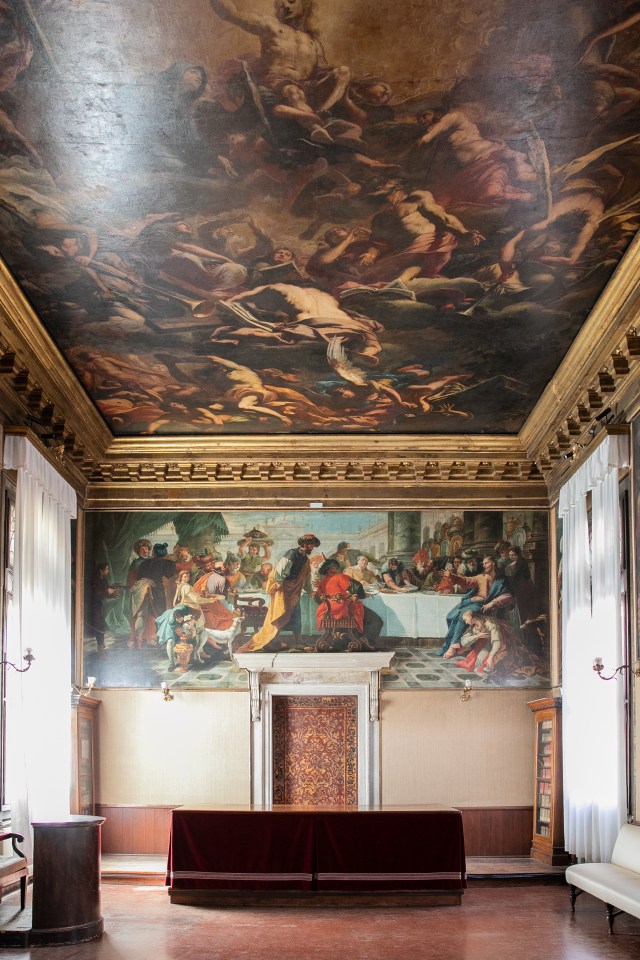
What came next, according to the ceiling of the building’s great hall, was Purgatory. After a fire gutted the original premises in 1562, the confraternity rebuilt on a grand scale, bringing in the architect Alessandro Vittoria and, for the decoration, three of the biggest names in Venetian painting: Tintoretto, Veronese, and Palma il Giovane. It’s Palma il Giovane’s work that stops people in their tracks — a cycle of thirteen ceiling paintings, completed in 1600, depicting Purgatory in unflinching detail. For two centuries, it was the last significant image the condemned men of Venice ever saw before they died. You don’t get much more noir than that.
The brotherhood didn’t survive Napoleon. When the Venetian Republic fell, the scuole were suppressed along with it, and the building passed to the Venetian Medical Society. In 1812, a Napoleonic decree merged that society with two literary and scientific academies to create something new: the Ateneo Veneto, a home for science, literature and the arts that has now been running, more or less continuously, for over two hundred years — making it, by its own proud claim, the oldest cultural institution in Venice.
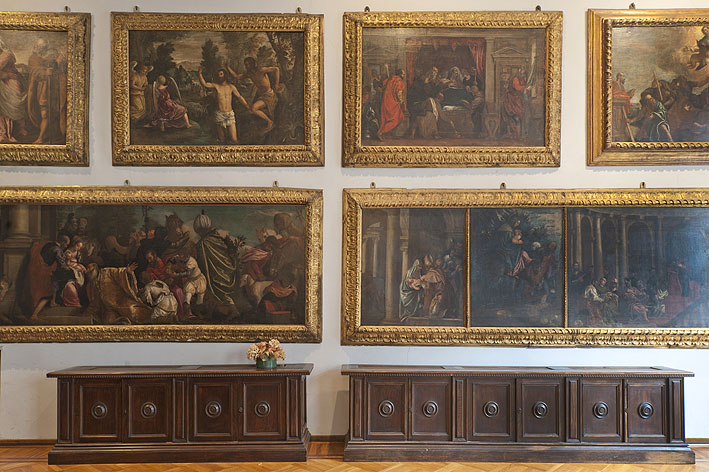
The art didn’t go anywhere. The old library reading room holds ten canvases of the Life of the Virgin by Veronese and his workshop, alongside four more Tintorettos. Elsewhere in the building, Palma il Giovane and later Baroque painters — Zanchi, Fontebasso, Corona — produced vivid scenes of judgment, penance and redemption.
The Ateneo Veneto still functions as a working academy — lectures, conferences, the occasional concert — and it’s through these relationships that outsiders get to slip inside at all. For a festival built around crime, guilt and the uneasy business of judgment, I can’t think of a more fitting room to gather in than one where the ceiling was designed, quite literally, to make the guilty think hard about what happens next.
And with Venice Noir you get to see all this for free.


Leave a Reply