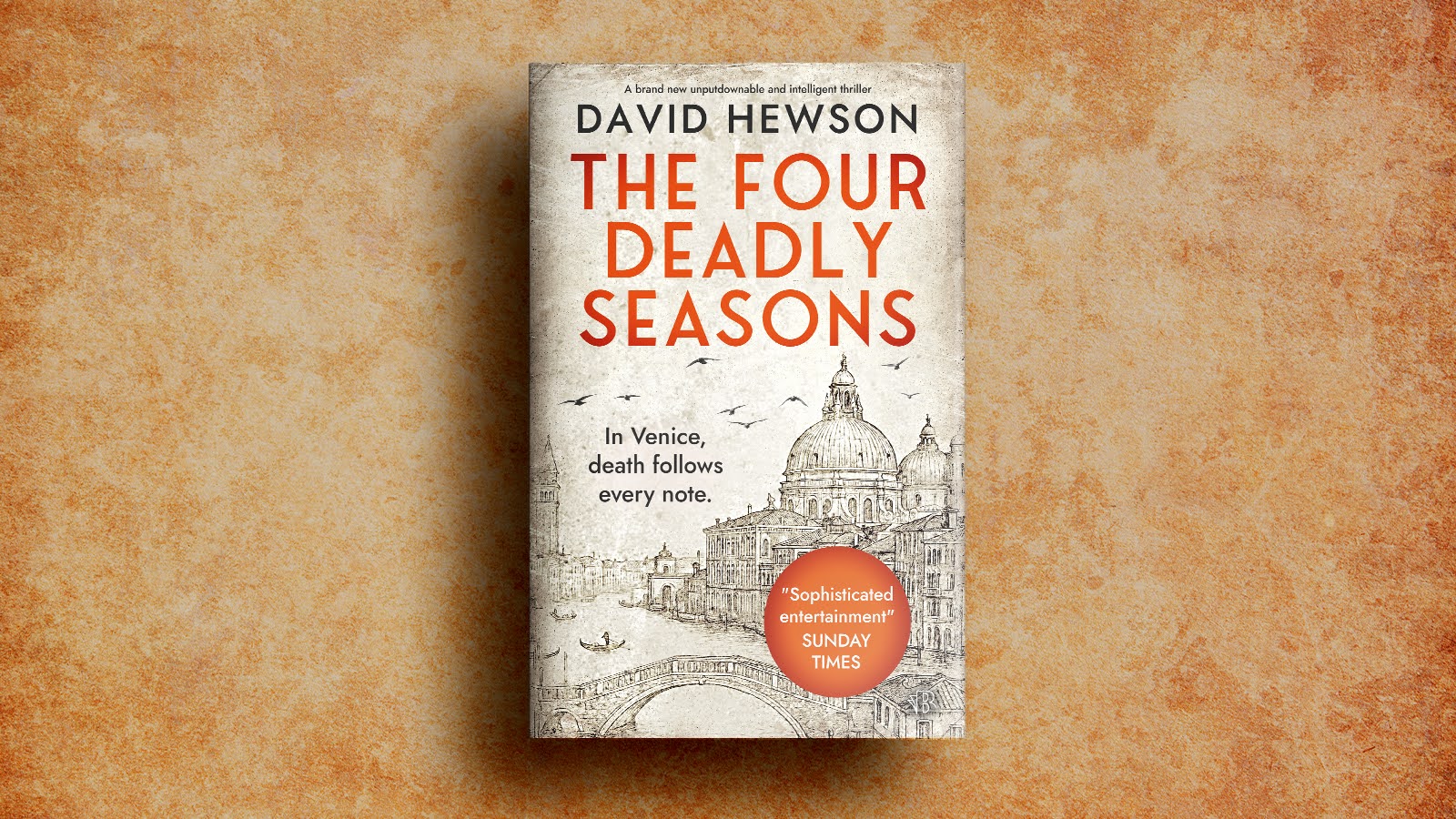
The audiobook of the third instalment of my Venetian mystery series, The Four Deadly Seasons, will be out from W.F. Howes on November 20, narrated like so much of my recent work by the wonderful Richard Armitage.
I feel very lucky to have Richard reading my stories, even if he’s so good at it I find I now struggle when I’m asked to read them myself at some event or radio interview as happened recently,
How do you compete with the master?
Well, you can’t. Richard really is at the pinnacle of the very difficult art of book narration, and now not just a superlative narrator and actor but an author in his own right. I’m immensely grateful he can still find time to read the likes of me, especially since I periodically throw at him some decidedly awkward Italian words and phrases.
It’s amazing to think that we’ve now been working together for more than a decade. Richard’s first project bore my name and that of my co-writer AJ Hartley when we produced a very adventurous rewrite of Shakespeare’s Hamlet for Audible. Later, he narrated my take on Romeo and Juliet, which won us a much coveted Audie, the audiobook equivalent of an Oscar.
Then, with my good friends at WF Howes, my audio publishers for more than two decades, Richard performed a stunning job with my World War Two Venice novel The Garden of Angels, followed by the first two books in my Venetian mystery series, The Medici Murders and The Borgia Portrait.
I feel very lucky to have such talent on my side, and hope we can one day tempt him to Venice Noir to talk about his extraordinary multi-faceted career.
There’s a pivotal scene in The Four Deadly Seasons that, like much of the book, is based on Venetian reality. Arnold Clover has been growing closer to Mia Haas, the woman who’s employed him to research Vivaldi’s supposed memoirs. Over a very unusual meal at a lovely, real restaurant near San Giacomo dell’Orio, the relationship suddenly becomes more serious.
The timing of this scene is crucial. It takes place during the Festa della Salute which happens every year on November 21. Venice has lots of festivals, but Salute is probably one of the most local and the most moving.
In 1630 a terrible plague hit the city, killing around 40,000 people, a quarter of the population. Among the victims were the Doge, Nicolò Contarini, and Giovanni Tiepolo, the Catholic patriarch. The great basilica of Santa Maria della Salute, at the mouth of the Grand Canal, was built to give thanks to the Virgin Mary for the lifting of the plague. Each year, for centuries, a temporary bridge has been erected to allow people to cross the Grand Canal and reach Salute directly.
There they can light candles asking the Virgin to protect their loved ones. It’s a sombre, quietly emotional event. I was there in November 2021 when the pandemic, another deadly plague for Italy, was in abeyance. I can still remember the extraordinary atmosphere inside Salute. Here’s a snippet of video I recorded that year, and another shot of the event is at the head of this post.
Venice is a city that loves its traditions, cultural landmarks that are strictly tied to the historic events that prompted them. In England you can buy mince pies in September, and hot cross buns almost all year round. The links that once bound tradition to specific dates are mostly gone. But not in Venice. You can only find frittelle during February for Carnival. And the period around the Festa della Salute is the only time you’ll see a uniquely Venetian dish on local menus, castradina, a speciality that goes right back to that terrible plague of 1630.
There are, as always, varying accounts for its origins. The convincing one for me is the most obvious: Venice was in quarantine, unable to receive much in the way of fresh produce. So it had to use what it had already, in this case a supply of salted, smoked mutton already shipped in from across the Adriatic… castradina.
Soon you’ll start to see those mutton legs hanging up in butcher’s shops across the city. They’re not terribly pretty to look at but this is tradition for the locals, not something looking for the tourist euro.
Now castradina only becomes available about a week before the 21st and doesn’t stay around long after. So I can’t say in all honesty you will see it everywhere during Venice Noir weekend. But one place I can guarantee you will find it is the very restaurant I used in that scene from The Four Deadly Seasons.
The Trattoria all Ponte del Megio has been serving genuine Venetian food from its delightful position by a little bridge since 1928. It’s in a lovely spot in a quiet corner of Santa Croce. The trattoria had been planning to serve castradina from the 15th. But as a special favour to Venice Noir it will now be available from Friday the 14th so you may find it makes a great place for lunch before the start of Venice Noir proper, and maybe meet a few other festival goers too. If I have the time I may make it there myself.
And you’re doubtless thinking… hang on this is a local speciality made with something I never knew existed, salted smoked mutton. Must cost a fortune… Well, no. At the Ponte del Meglio it will be just €15 per person, and available for two weeks from the 14th. With a nice glass of red wine you will be set up for the day for around €20 I’d say.
What’s it like? Well really you have to try it to know. This, remember, is a dish that was invented during quarantine and a plague. It’s not haute cuisine. This is the genuine cucina povera. I’m no food writer but I’d describe it as a very hearty soup cum stew, winter vegetables, a very real meaty stock, and chunks of mutton in there. For me it’s a perfect hearty lunch for one of those crisp winter days you get in Venice in November, and when I ate at the Ponte del Meglio I was lucky enough to sit outside next to a couple of cheery gondoliers downing a couple of bowls too. If you have the time on the 14th it could be a great way to start the day before Venice Noir proper begins. And go home knowing you’ve sampled a dish you won’t find anywhere else in Italy pretty much, and for only a couple of weeks each year.
Here’s an amusing video about Castradina – it’s in Italian but you can switch the subtitles to English. I love the fact he’s cooking with a spoon in one hand and a glass of wine in the other — my sort of chef!
This will, I’m sure, come as a great surprise to all of you but Philip Gwynne Jones and I have been known to partake of food and the odd drink while doing all that necessary book research in Venice. It only seemed fair to share with you a few of our recommendations for finding sustenance during the festival. Or any other time come to that…
And here’s news of two informal cocktail evenings at during the festival, one where I talk to Ian Rankin, and the second at which Philip and Gregory Dowling will discuss drink and books — with the invention of a new cocktail named after Venice Noir. Places for these events are strictly limited since they will take place in two of the finest and intimate cocktail bars in Venice. If you want to come, book now.
Philip first…
Crime and Cocktails
As those of you who follow my Venice novels might know, Nathan Sutherland does enjoy a drink. Negroni by preference, Spritz by necessity. Crimes, after all, are unlikely to be solved following a mid-morning Negroni.
This has, of course, meant a considerable amount of research on my part. But, in the cause of authenticity, that’s just the sort of thing a writer has to do from time to time.
Now, if you’re attending the festival, you’re likely to be spending a lot of time in the area around the Ateneo Veneto. You’re going to need somewhere, then, to squeeze in a restorative drink and a bite to eat in between panels. Fortunately, the American Bar at the Taverna La Fenice is almost right next door, and they serve an excellent Spritz and cicchetti as well as more substantial bar snacks.
Of course, we’re only about five minutes walk from Piazza San Marco and you’re going to want to check that out. It’s very tempting to go to Florian or Quadri which indeed are lovely but you’ll be paying a lot for the experience. Instead, head for the Gran Caffè Lavena. And here’s a tip for you – don’t sit down but stand at the bar and you’re paying normal prices! They might even throw in some crisps. It was good enough for Richard Wagner and so it’s good enough for me.
Head in the other direction, towards Campo Sant’Angelo, and you’ll come across Nathan Sutherland’s local the Caffè Brasilia (or “The Magical Brazilians) in the Rio Terà dei Assassini. It’s changed hands a few times over the years, but it’s still good. And you really do need to check out the Negronis here.
Head a bit further afield, over to Dorsoduro, and a Spritz outside Nico’s on the Zattere is always a pleasure on a fine day. However, should the weather drive you inside (and we are going to be in the middle of November after all), then why not check out “Corner Pub” (or, as Nathan calls it, “Church Pub”) in the Calle de la Chiesa. Alessandro, Virginia, Mercedes and the rest of the staff are all lovely, there’s a terrific selection of panini, focacce and polpette of every description, and Alessandro makes a mean Negroni!
Now, together with David’s recommendations, I think that should be enough to keep you comfortably fed and watered over the weekend. But if that isn’t enough, why not join us for two special cocktail evenings?
At 7pm on Friday 14th, David will be in conversation with Ian Rankin at La Rivista Restaurant, Ca’ Pisani. You’ll definitely need to reserve for this one (at €30 per person), so write to ristorazione@capisanihotel.it .
Similarly, at 7pm on Saturday 15th, Gregory Dowling and I will be discussing some of the great figures – and drinkers – in crime fiction. More than that, we’ll be unveiling the official cocktail of the festival in the wonderfully noir-ish space of the bar at the Palazzo Experimental on the Zattere. Again, spaces are verylimited for this one, so reserve your ticket (30 euros) by writing to adriatica@palazzoexperimental.com
We look forward to meeting you, hopefully over a drink or two, in Venice!
Now my turn…
My first recommendation is don’t dine near the Piazza San Marco unless you know what you’re doing. Outside the hotels, some of the places are very touristy. But here’s an exception. Il Ridotto is a charming little restaurant in Campo Santi Filippo e Giacomo. Just nine tables so you must book and you’ll pay San Marco prices. But it’s a lovely spot and the Hotel Rio opposite was once home to Vivaldi.
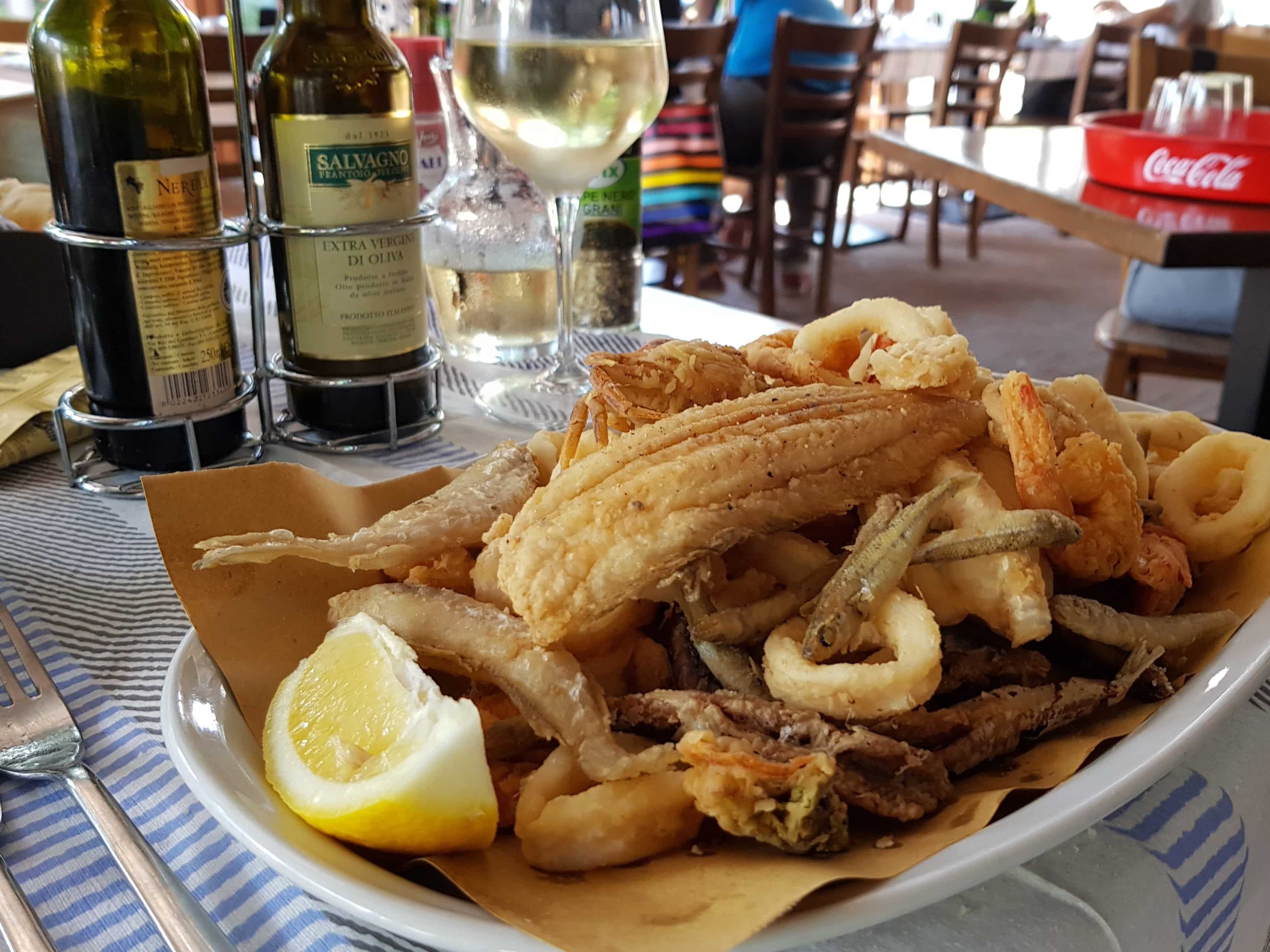
I like to catch a boat to the Lido and enjoy the very local Al Merca, situated in the old market a ten-minute stomp from the vaporetto stop. Reliable local food, always a pasta dish and fish main course of the day, and there’s a very popular cichetti bar attached too. Bestbooked through Quandoo. That wonderful frittura mista at the top of the post is theirs. If the pasta of the day happens to be spaghetti alla busara, a dish from Trieste made with lagoon mantis shrimp, grab it. This is the one I had a while back and it was superb.
Spaghetti alla busara at Al Merca on the Lido
There’s always someone who wants meat, of course, and for that you need to find LaVacaria where you can even enjoy the legendary Fiorentina. It’s in an interesting out of the way location on the Fondamenta de L’ Arzere. Al Canton, the cafe next door is a great spot for lunch and breakfast too. The name, by the way, doesn’t just refer to the fact this is a meat restaurant. Not so long ago there used to be cows grazing in this area on the edge of Dorsoduro.
These are all serious restaurants but you can eat for a lot less. I love the traditional carbonara at Bakarò in Campo Santa Margherita — as good as any in Rome and you can eat outside in the square if the weather’s good enough.
Margaret Duchamp (see if you can work out the name) is a great pub in the same square with a decent range of inexpensive panini and other light meals. Nearby you’ll also find good pub grub and excellent negronis in Cafe Noir and around the corner on the way to the Frari some of the best cicchetti in town at Bacarotto. Now for two places you’ll find Arnold Clover and Luca Volpetti visit regularly in my books. The Osteria ai Pugni is a long-time favourite bacarò with inexpensive lunchtime meals if you can get a table. And Adagio is the friendly cafe by the Frari they head for during breaks from the nearby Archivio di Stato. Nice cicchetti too…
Cicchetti at Adagio
If you crave a fancy three course lunch you’ll usually find a fantastic 40 euro menu at the close by Il Refettorio. This is a very pricey place run by the Majer chain in the evening, but much more affordable at lunchtime. They usually do octopus, below. Here’s the current lunchtime menu to whet your appetite..
And finally for a very memorable cocktail head for the beautiful old cafe of Il Mercante near the Frari. A very old establishment that used to be known as the Caffè del Frari, and in the 19th century had a famous cat visited by all manner of celebrities over the years.
Cin cin!
Inside Il Mercante, an elegant and historic place for a cocktail.
The third book in my Venice mystery series is now out worldwide in print and ebook from Bloodhound Books. You can find it online and order print versions on the web and through conventional book stores.
Arnold Clover is back in his finest adventure yet. A rollicking, operatic read from a writer who both loves and understands the city. – Philip Gwynne Jones
A centuries-old score. A city built on secrets. A melody that kills.
When a mysterious music impresario is found dead in Venice—his body slumped in the hot house of a remote palazzo, a cryptic musical interval in his hand—rumours swirl around a rediscovered manuscript: the original score for The Four Seasons, penned in Vivaldi’s own hand.
But is it a masterpiece lost to time or a masterful forgery?
Arnold Clover, a reclusive British archivist seeking peace in the city on the lagoon, is reluctantly drawn into the mystery. Hired to authenticate the deadly manuscript, Arnold finds himself at the centre of a chilling conspiracy that spirals through shadowy music chambers, forgotten archives, and bloodstained Venetian alleyways.
As the seasons change, so does the tempo of the killings. With each movement of Vivaldi’s immortal work, another victim falls.