Forget the crowds in San Marco and Rialto. There’s a lovely walk you can make to escape them along a broad promenade with beautiful views and piles of history. This is the Zattere which runs along the Giudecca Canal from San Basilio to the famous viewpoint at the very tip of the Grand Canal.
It’s nearly two kilometres of open pavement — and yet it rarely feels crowded except when it comes to the autumn marathon which usually sees packed hordes of runners headed for the temporary bridge across the Grand Canal at the end.
Zattere means rafts, and that’s exactly what this stretch of shoreline was for centuries before it became a promenade at all — a landing point where timber floated down from the mountains on rafts, destined to become the pilings that Venice itself stands on. The pavement wasn’t laid until 1519; before that, this was simply mud and logs and the business of building a city.
Let’s walk it from start to finish.
Starting at San Basilio

The walk begins at the very local vaporetto stop of San Basilio. This is a very local part of the city. There’s plenty to see but little is on the main tourist circuit. Around the corner and across the narrow canal lies the church of San Sebastiano, decorated by Veronese who is buried there. A little further into Santa Marta you’ll find the church of San Nicolò dei Mendicoli, featured in that Venetian classic Don’t Look Now. Across the water lies the hulk of the Stucky Hotel complex and next to it the premises of the Fortuny showroom and factory.
But this is still a working, local part of the city, with a small port building with sailings to Croatia by the side.

If you’re around during the summer and fancy a trip to the beach there’s a charming way to get there — the Number 8 vaporetto, an open boat for beach goers that crossed the lagoon and goes to the San Niccolò stop on the Lido where there’s a short walk to the Adriatic shore. Pretty much empty at San Basilio, it picks up locals from Giudecca and Giardini along the way until at the weekends it’s heaving with happy families looking forward a day on the beach.
A maritime past

You’ll soon see a sign of Venice’s imposing maritime past: this Gothic-arched palazzo was once the headquarters of Adriatica di Navigazione, the great state-backed shipping line formed in 1932 by merging half a dozen regional firms from Venice, Bari, Fiume, Ancona and Zara. By the mid-1930s Adriatica ran a fleet of more than thirty ships on routes to Yugoslavia, Albania, Greece, Egypt and Turkey, with passenger vessels once mooring right along this stretch of fondamenta.
The company survived the loss of nearly its entire fleet in the Second World War, rebuilt through the 1950s and 60s — pioneering one of Italy’s first long-haul roll-on/roll-off ferry routes in 1961 — and finally merged into Tirrenia in 2004, ending 72 years as an independent line. The Adriatica name hasn’t disappeared, though: it survives in mosaics on the building’s facade, and today the palazzo itself is Il Palazzo Experimental, a boutique hotel whose restaurant, fittingly, is called Ristorante Adriatica. The Experimental is one of the partner hotels for Venice Noir so you will find some of our authors staying there in November, and you can book rooms at a festival discount too. Plus watch out for a cocktail reception with one of our writers there too. Sign up to the Venice Noir newsletter to be the first to hear.
Giudecca, Across the Water
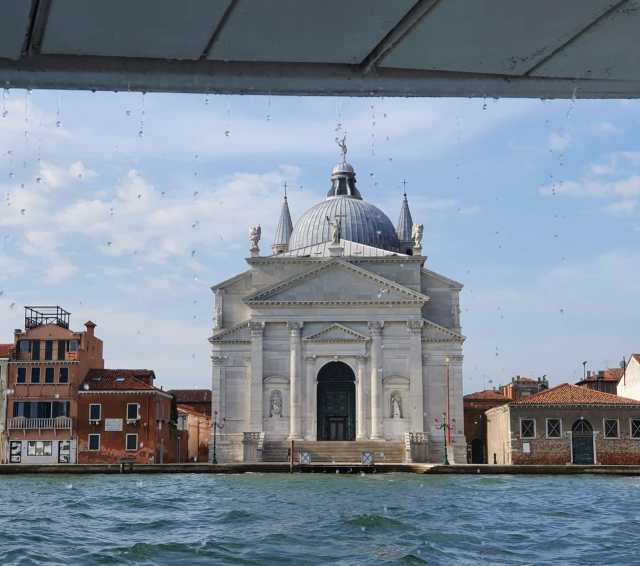
The island across the water gives its name to this broad Canal… Giudecca. You’ll read in the tourist books that Venice has more than 150 canals. In truth it has only three — the Grand, the Cannaregio and the Giudecca.
Il Redentore, the island’s defining monument, arrived after the 1575–76 plague killed a quarter to a third of Venice’s population: Palladio’s votive church Il Redentore, begun 1577 and consecrated 1592, which the Doge and Senate crossed a pontoon bridge to visit each year — a ritual that survives as the Festa del Redentore every July. Redentore is now a massive festival attracting huge crowds, for that walk across the canal and the spectacular fireworks. If you plan to go, book well ahead, and remember you’ll either have to pay the city tax if you’re a day tripper or get an exemption if you’re staying in a hotel or apartment.
Gelato time

By now you’ve earned a pit stop and right by the Zattere vaporetto jetties you’ll find the perfect place to enjoy it. Nico’s is one of the most traditional cafes and ice cream makers in Venice, and with lovely views from the outside tables. Reliable, reasonably priced and so far ignored by the Instagram crowd. I can’t recommend it enough.
The Gesuati

The real architectural statement on this walk is the Gesuati, properly Santa Maria del Rosario — a Rococo church whose ceiling was painted by Tiepolo. It’s the single most photographed building along the route, and deservedly so: the facade sits right on the water, and the light off the Giudecca Canal in the afternoon does it real favours. You can read all about it on the fantastic website The Churches of Venice which is a must for anyone exploring the city’s religious institutions. Find the Gesuati here.
Anyone who’s read The Borgia Portrait will recognise one odd architectural feature as a clue in the book.
Ruskin’s favourite place to stay

Next up the place to stay on the Giudecca. The Pensione Calcina was once a warehouse for limestone sellers, hence the name, that turned into lodgings to meet the foreign travelling trade. Its most famous customer was the art historian John Ruskin, who returned to Venice in the winter of 1876–77 after an absence of sixteen years, choosing the modest Calcina to escape the crowds at the grander hotels. It was during this stay that he suffered one of his worst breakdowns, becoming obsessed with Carpaccio’s paintings of Saint Ursula in the nearby Accademia — convinced the saint had somehow merged with the spirit of Rose La Touche, the young woman he’d loved, who had died the previous year, never having returned his affections.
Spirito Santo

The rather sad-looking church of Spirito Santo gives its name to the vaporetto stop outside. Closed for years in this very quiet corner of Dorsoduro, it’s now being converted into a library for Ca’ Foscari, the Venice university. Readers of The Medici Murders may remember it was here that the assassins of Lorenzino de’ Medici hid after his murder, avoiding the Venetian guards before hopping on a gondola across to San Marco.
The place for salt

Not far along, the Magazzini del Sale — the old salt warehouses — line the fondamenta. This is the domain of Reale Società Canottieri Bucintoro, Venice’s oldest rowing club, founded 1882. If you’re in town when there’s a big rowing event you’ll see a range of different craft getting manoeuvred into the water here alongside busy teams of male and female rowers.
Approaching the Dogana

As the promenade narrows toward its end, the old customs house comes into view — weathered stone topped by a golden globe held aloft by two bronze figures of Atlas. This building has done the same job for six centuries: marking the point where ships arriving from the sea once met customs agents at the entrance to the Grand Canal.
Punta della Dogana


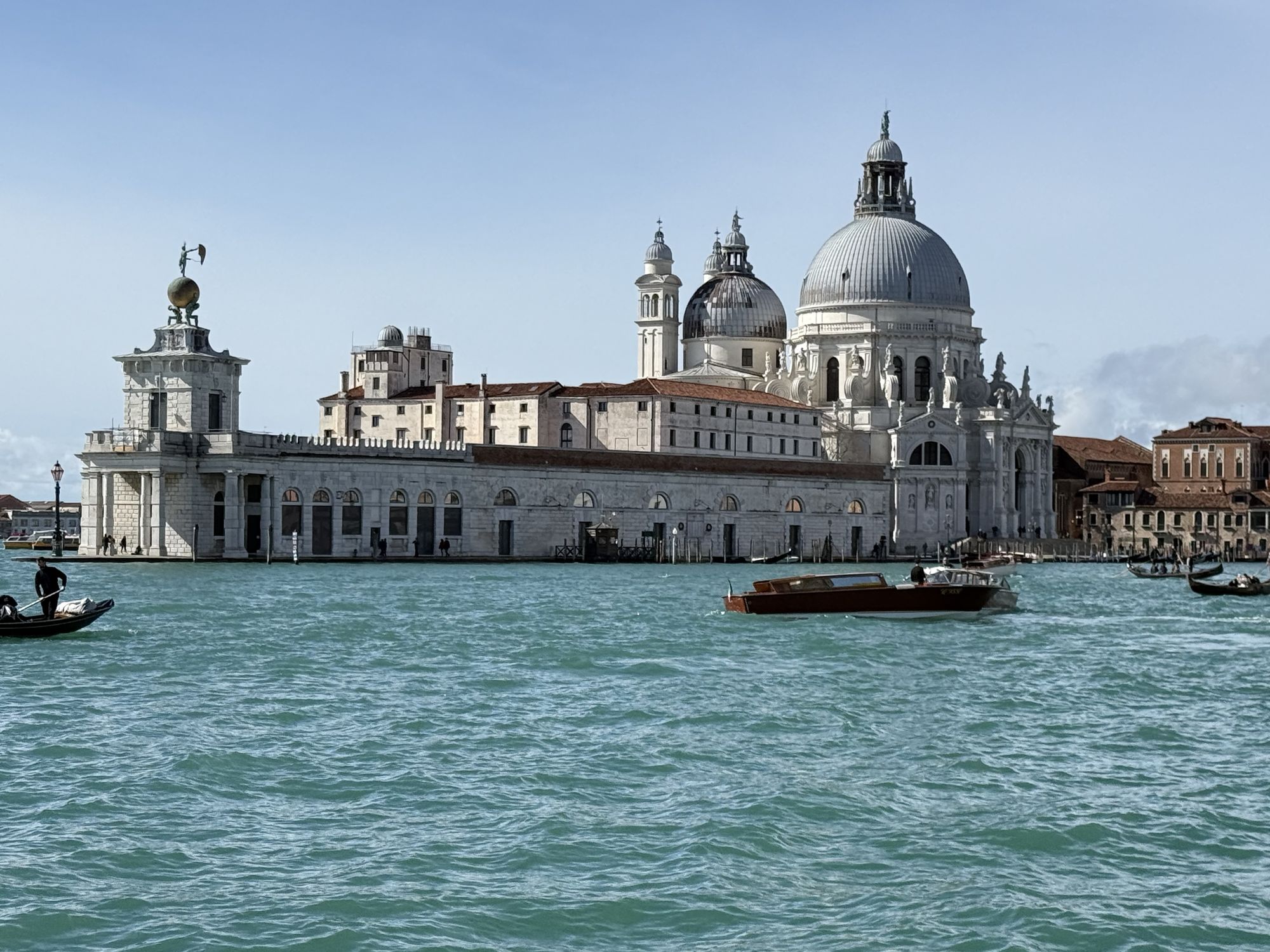
And then, at the very tip, the walk delivers its payoff. This is the triangular point where the Grand Canal meets the Giudecca Canal, and from here you get the view every tourist’s postcard is chasing: the Bacino di San Marco laid out across the water, the Doge’s Palace and the campanile visible from an angle almost nobody photographs from the other side. Behind you, Santa Maria della Salute rises — which is why locals sometimes call this whole corner Punta della Salute instead of Punta della Dogana.

The Punta della Dogana tower. The 17th century sculpture at the top depicts the Atlantes: two muscular bronze Atlas figures holding aloft a gilded bronze sphere representing the world. A statue of Fortune tops the globe and spins with the wind to show its direction.
It’s a lovely walk with views that change according to the season. Here’s a shot from January 2019 of a cormorant raising its wings to get the most of some winter sun.

And if you get to the end and want to get to San Marco quickly just walk around the corner and catch the traghetto, a large public kind of gondola. That will take you across the Grand Canal for just €2.