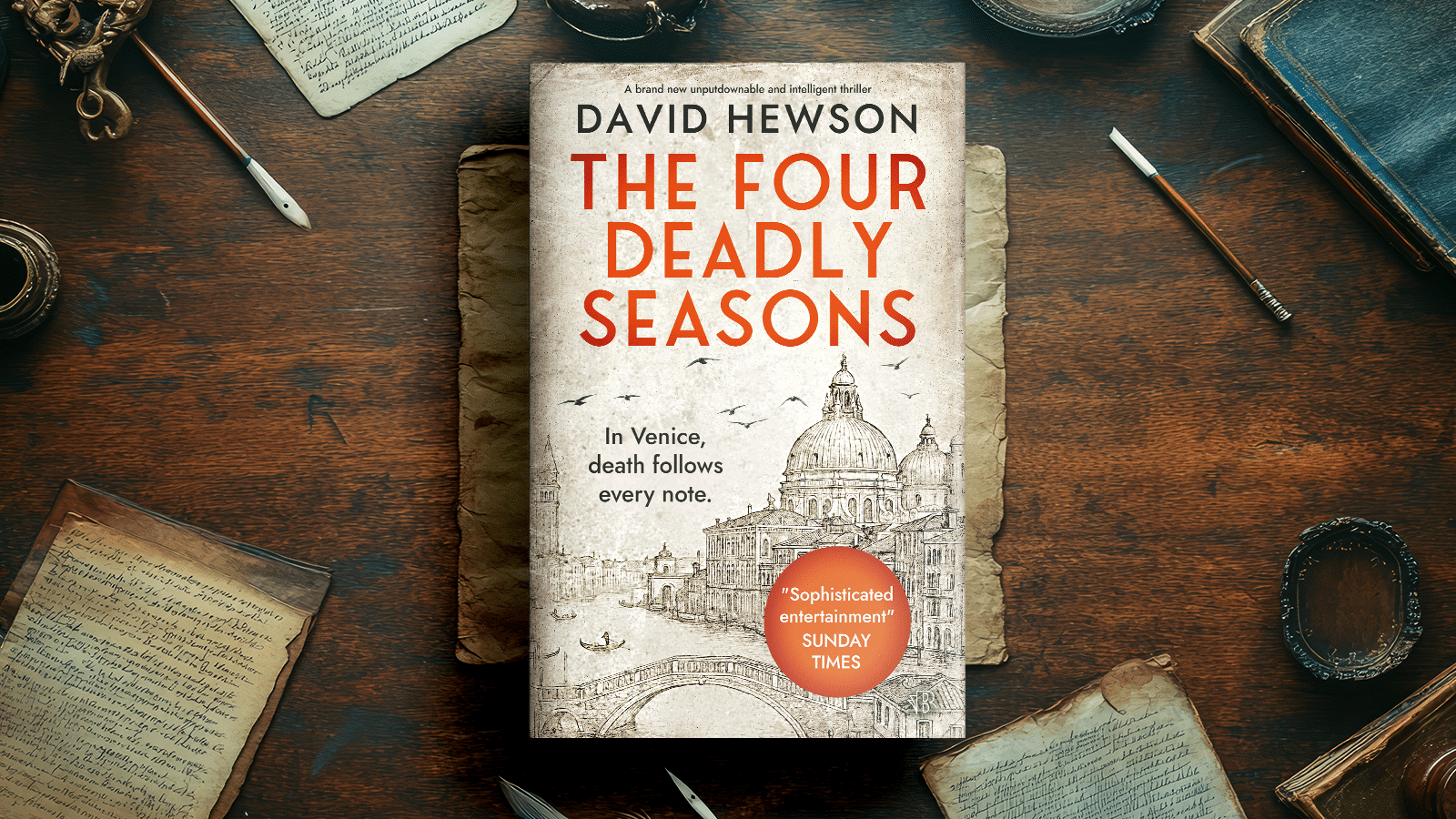
It’s time to get back to Venice, on this occasion for a narrative that takes part over a whole year.
A story that follows the structure of a piece of music that’s at the tale’s heart… Vivaldi’s legendary Le Quattre Stagione. The Four Seasons.
A story about music, obsession and revenge.
There’s a very simple setup to Arnold’s latest adventure. Or so it seems. His chum Luca Volpetti from the Venice State Archive, along with a little help from Valentina Fabbri, the Carabinieri capitano, have fixed a job for him to deal with his straitened finances. Arnold has been lured over to an obscure part of Giudecca where an old palazzo is being restored as both a fancy hotel and a concert venue devoted to Vivaldi who once conducted there. The new owners are certain he’s the man for a curious task they have in mind.

The job is quite outside his experience — putting together a popular history book about the life of Vivaldi, ostensibly from some new research material that’s been uncovered by the couple behind the venture. All the same Arnold’s talked into accepting. But then a tragedy throws the entire project into jeopardy, and he finds he’s having to research the book on his own, travelling to Vienna to try to work out what’s real and what’s not.
It’s a broad story, like the work itself covering all four seasons in Venice, each of them markedly different in character and tone. Is he really discovering the truth about one of the world’s most famous yet elusive composers? Or part of a gigantic fraud being carried out for reasons he can’t fathom.
An adventure then, one in which he finds himself in some peril at times, and in the company of a woman he comes to admire.

The background
It’s not hard to find things to write about in Venice. Though on this occasion it was what I couldn’t find that sparked the story, not some arcane discovery. I love walking round the city chasing its famous ghosts, the places they lived and worked, sometimes the places they died.
Here’s the oddity when it comes to one of the most famous Venetian’s of all, Antonio Vivaldi, the so-called Prete Rosso or Red Priest. We know where he was born, in this modest square in the eastern part of Castello, just beyond the busy San Marco area. We know he was baptised in this church too; his birth certificate is still on the wall.
After that… you’ll hear his music everywhere, of course. In concerts, in restaurants, played on the street at times. But is there a plaque to show where he lived? None that I can find, and I do know all three of his known homes. Is there a reliable biography of the man? Not really, for a remarkable reason. If you’d access to a time machine and could beam yourself back to the Venice of a century ago then asked a local, even a musical one, what they thought of Vivaldi and The Four Seasons they would have looked at you dumbfounded.
He may be one of the most famous composers in the world today, but for almost two centuries after his death, as a forgotten pauper in Vienna, Antonio Vivaldi was unknown. Vanished from musical history until an extraordinary sequence events involving Mussolini, a fascist American poet, war and a new consumer technology set him on the route to posthumous stardom.
There’s the backdrop of The Four Deadly Seasons, full of riddles Arnold must try to resolve.
The locations

A lot of the action takes part in a place that doesn’t exist, the former Colonna-Ottoboni at the edge of Giudecca. The inspiration for this is a mysterious patch of abandoned land on Giudecca known as The Garden of Eden. There’s nothing to see from the outside — I’ve tried — so best to take a look on Google Maps. An odd place with a very curious back story you’ll find told in great and interesting detail here. It has nothing to do with Vivaldi or music, and a little to do with that funny English drink Horlicks along with Jean Cocteau, Marcel Proust and Henry James. Still, wandering around this out-of-the-way bit of Giudecca is always delightful, especially if you stop off at the Redentore Gardens along the way.
Chasing the ghost of Vivaldi invariably involves hanging around Campo Bandiera e Moro where he was born, and popping into the church of San Giovanni in Bragora to see the font he was dunked in and his birth certificate. If you want a snack and a drink in a genuine Venetian bacarò I recommend Alla Rampa around the corner.
There’s precious little left that Vivaldi would recognise today. La Pietà on the Riva degli Schiavoni is often touted as ‘Vivaldi’s church’ but it isn’t. The place where he began his career was demolished not long after his death and the present building erected on the same site. His former homes include what is now the Hotel Rio, a house at the Ponte Paradiso, and a building next to the Palazzo Bembo close to the Rialto. Not that any pf them appear to mark the fact.
The same lack of detail accompanied Vivaldi to his sad end, broke, forgotten, ignored in Vienna where he died in a cheap lodging house in July 1741. He was buried in a pauper’s cemetery that is now the public park in front of the Karlskirche. At least there, close by to what must be his grave, there’s a plaque

Venice Noir
This a very Venetian tale, even with Arnold’s side trip to Vienna. So I’ll be talking about it at Venice Noir on November if you manage to make it there.