Every city collects its eccentrics, and Venice has had more than its fair share over the centuries. But few as strange as ‘Baron Corvo’.

Frederick William Rolfe was his real name, born in Cheapside in 1860, the son of a piano maker. He wanted three things: to be a priest, to be a nobleman, and to be recognised as a genius. He failed at the first, invented the second, and managed the third only after he was dead. Twice he trained for the priesthood and twice he was shown the door, mostly because of appalling behaviour. After that he reinvented himself as Baron Corvo, a title that, as far as anyone can tell, he awarded himself, supported by a hazy story about an Italian duchess. Corvo means ‘crow’ in Italian. It suited him. He wrote under a whole flock of other names as well.
He wrote real books. Chronicles of the House of Borgia appeared in 1901, and the title often acclaimed as his masterpiece, Hadrian the Seventh (1904), is a feverish fantasy in which a rejected, impoverished English writer is unexpectedly elected Pope. It is the purest wish-fulfilment ever put into a novel, and quite nuts. Take a peek at it on Gutenberg to get the flavour of it. When I came to write The Borgia Portrait, Corvo turned out to be exactly the kind of figure a Venetian puzzle needs. I won’t say how he figures in the book, but if you’ve read it you’ll know he’s there for a reason.
What Rolfe could never manage was to keep a friend, a patron or a publisher. It wasn’t just that he was openly gay, given to taking risqué photos of his boyfriend, and hanging out with dodgy gondoliers. A pattern repeated itself throughout his life: someone would take him in, feed him and support him, and within months he would be denouncing his benefactor in letters of astonishing venom. He ended up in Venice, which in those years was teeming with wealthy foreign residents and, for a man like Rolfe, full of expats to sponge off and quarrel with. By the time he died, on 25 October 1913, he was penniless and in debt to half the city. The cause was a stroke or heart failure, depending on which account you read. He was fifty-three.
It’s fair to say the English community did not go into deep mourning.
That might have been the end of him, and for twenty years it was. Then in 1925 a young bibliographer called A. J. A. Symons was asked by a friend whether he had read Hadrian the Seventh. He hadn’t. He read it, was bewitched, and set out to discover who had written it. The result, The Quest for Corvo, appeared in 1934 and is one of the oddest and best biographies in the language. Symons called it an “experiment in biography”, and it is really a detective story: the biographer tracks down the surviving witnesses, follows leads that go cold, and pieces Rolfe together from the testimony of people who mostly wished they hadn’t met him. Symons’s brother Julian was a well-known crime writer (check out The Tigers of Subtopia), and Symons said he wanted to write a biography in the form of a detective adventure. You can see why I like it. Rolfe is still the man at the centre, and still impossible.
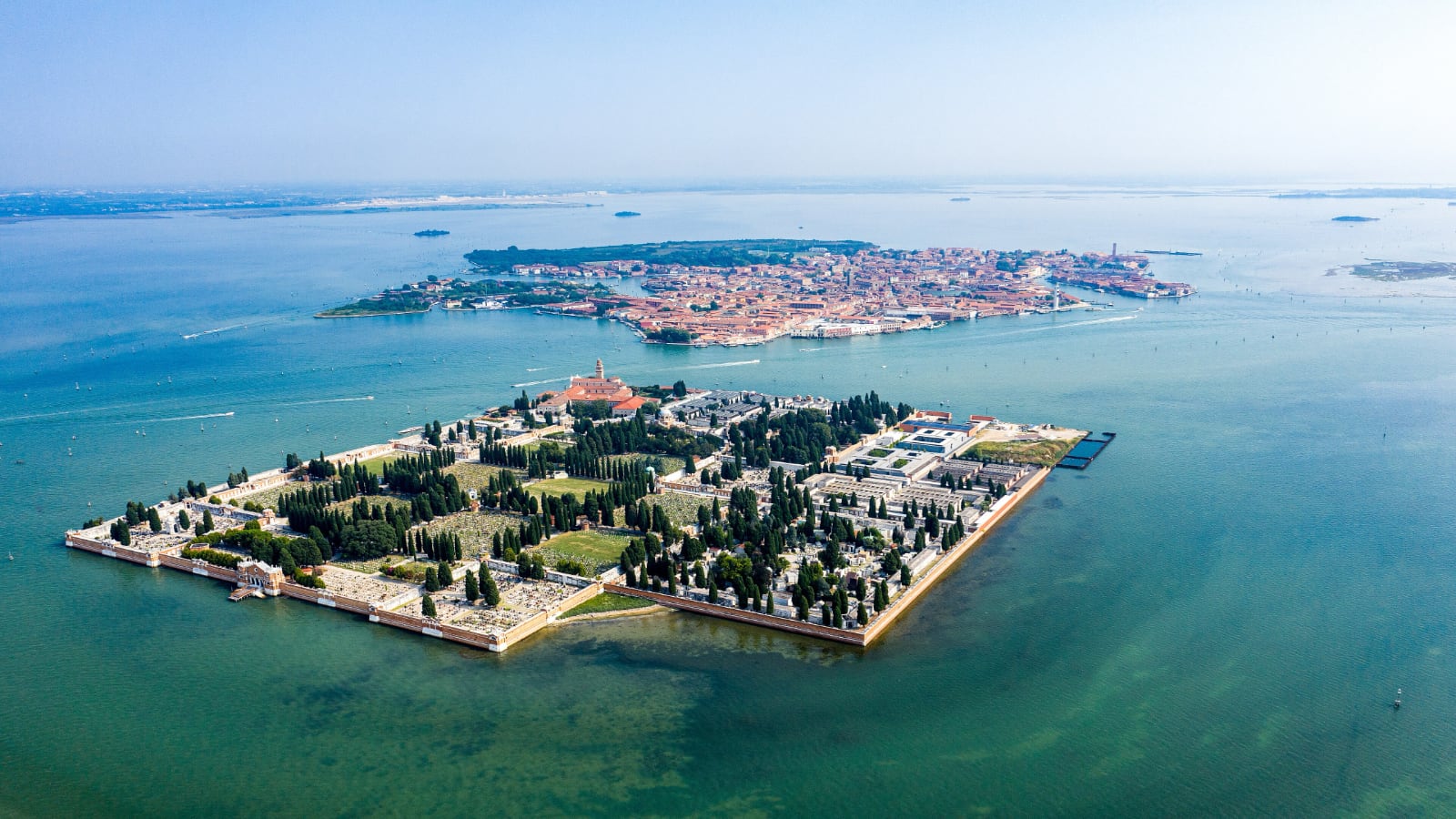
Venice is where the story ends. Rolfe lies on San Michele, the cemetery island you can see from the Fondamente Nove. According to the New York Times, his grave is in Recinto 7, in the terraced wall crypts along the northwest wall (crypt vt 13, row 6a). It’s a modest berth for a man who spent his life convinced he deserved a throne, but a fitting place for someone so obsessed with the city. He wrote about it too, in the posthumously published The Desire and Pursuit of the Whole, a thinly disguised and viciously funny portrait of Venice and its foreign colony. Several people in it did not take kindly to being recognised, including the American hosts who’d been accommodating him. They threw him out on the street when they saw what he’d written.


Next time you take the vaporetto to Murano and the island slides by behind its brick wall, spare a thought for the curious Frederick Rolfe. A conman, a snob, a sponger and a failed priest, who also happened to be a writer of real, if exasperating, genius. And if you want to see what a Venetian mystery can do with a man like that, you’ll find him in The Borgia Portrait, along with the rest of the Arnold Clover series.
Header image: aerial view of San Michele by Kasa Fue, CC BY-SA 4.0, via Wikimedia Commons. Cropped and resized.

Leave a Reply