Category: Venice Noir

  • The Three ‘Moors’ of Cannaregio: A Walk Around Campo dei Mori

    The Three ‘Moors’ of Cannaregio: A Walk Around Campo dei Mori

    Venice doesn’t just tell its astonishing history through books and paintings and music. It’s there in the streets too, if you just stop to look. Let’s take a walk around a quiet part of Cannaregio and I’ll show you an example many often miss.

    The ‘Moorish’ statues

    Head to Campo dei Mori and you may find a few people hanging around this statue and touching its iron nose.

    The statue of Sior Antonio Rioba in Campo dei Mori, Venice, with its iron nose

    That’s Sior Antonio Rioba, the most famous of the four figures built into the walls in this area, distinguished by that iron nose that replaced his original stone one sometime in the 19th century. Rub it, tradition says, and you’ll have luck. These visitors from India had a good old rub before moving on.

    Visitors rubbing the iron nose of the Sior Antonio Rioba statue for luck

    Rioba was, for centuries, Venice’s answer to Rome’s most famous talking statue Pasquino — a spot where anonymous satirical notes aimed at the powerful would appear, tucked into his stone folds or read aloud by whoever found them. You can still see it right by Piazza Navona today, along with some contemporary diatribes. Rioba and his two stone companions in the same campo — Sandi and Afani — are traditionally identified as the three Mastelli brothers, merchants who arrived in Venice from the Peloponnese.

    One of the stone Moor statues in Campo dei Mori, Venice

    No, they’re not from North Africa

    The brothers were nicknamed “Mori” because they came from Morea — the old name for the Peloponnese — not because of their appearance. A Marciana Library chronicle (Codice 27) dates their arrival precisely: 1112, fleeing civil unrest at home with considerable wealth, which they used to build the palazzo that still stands on the campo.

    The statues themselves came later — probably carved in the late 13th or early 14th century, nearly two hundred years after the brothers actually arrived.

    Palazzo Mastelli del Cammello

    A few steps away, the family’s palazzo reveals the other half of its story: a camel in bas-relief, carved into the façade facing the water.

    The camel carved in bas-relief on the façade of Palazzo Mastelli del Cammello
    Palazzo Mastelli del Cammello, the 'House of the Camel', on the Cannaregio canal

    One legend holds that the brothers’ own camel was petrified alongside them. A gentler, more romantic version claims a wealthy Eastern merchant had it carved so a woman he loved might recognise the house, should she ever come looking for him. Either way, Venetians have long known this simply as the “House of the Camel.”

    The uglier version of the Mastelli story — the one Alberto Toso Fei tells in Misteri della Laguna e racconti di streghe — has the brothers as fine-fabric merchants who made a habit of cheating their customers, until they picked the wrong one: a devout Venetian widow who, once defrauded, prayed to Mary Magdalene for justice. The saint, in the guise of an ordinary buyer, returned to trade with them — and turned them, and by some tellings their camel too, to stone on the spot.

    The fourth statue, and Tintoretto’s doorstep

    Round the corner, on the Fondamenta dei Mori, is the detail most visitors miss entirely: a fourth statue, set into the wall of what later became Tintoretto’s house.

    The fourth Moor statue set into the wall on the Fondamenta dei Mori, near Tintoretto's house

    Toso Fei is one of the few writers who gives this one a name — el Moro Mambrun — distinct from the three brothers themselves; other tellings call him their servant.

    And on to Madonna dell’Orto

    While in the area you shouldn’t miss the church Tintoretto is buried in.

    The church of Madonna dell'Orto in Cannaregio, where Tintoretto is buried

    It’s a minute’s walk from the campo, and a delightful, peaceful location to end this little stroll around one of Venice’s many fantastic tales, from petrified merchants and their camel to the brilliant painter who lived and worked in their shadow for most of his life.

    If you want to know more of this side of the city, Alberto Toso Fei is your author, and has some works translated into English which are well worth a read. I’m delighted to say he is one of the team working on Venice Noir too so if you come to join the festival in November you’ll have the chance of hearing him talk about the city he knows so well, and where his family connections go back centuries. Worth the trip alone.

  • Lama d’Ombra: The Glass Blade That Will Crown Venice Noir 2026

    Lama d’Ombra: The Glass Blade That Will Crown Venice Noir 2026

    We conclude Venice Noir with our award to a writer we feel has made a significant contribution to the field of crime and thriller writing. Last year our first prize went, deservedly, to Ian Rankin who you can see testing the sharpness of it below…

    Ian Rankin testing the blade of last year's Venice Noir award, a glass sculpture from a Murano furnace.

    Yes, it was a stunning piece of glass sculpture made by Barovier & Toso, one of Murano’s most famous furnaces. This year, thanks to the efforts of Marco Vidal, our champion on the ground in Venice alongside his wife Silvia Bandolin, we have another unique sculpture, one with a name: Lama d’Ombra — Blade of Shadow.

    Lama d'Ombra, the glass and wood sculpture Andrea Morucchio created as the official Venice Noir Festival 2026 award

    The piece is the work of Andrea Morucchio, an artist Marco has collaborated with for years and who, he says, never fails to come back with something extraordinary. A few months ago Marco asked him to create the trophy that will be presented to the Noir Author of the Year — the prize that sits at the heart of everything the festival stands for.

    ‘What he’s made is, without exaggeration, a showstopper,’ Marco says proudly.

    A blade cut from glass and shadow

    Marco again, ‘Lama d’Ombra marks Morucchio’s return to sculpture in glass, reworking a form that sits at the very origins of his artistic research. It’s a vertical, edged presence — a blade, unmistakably — rendered in a red so deep it reads almost as blood, rising from a base of blackened, charred-looking wood.

    ‘The effect is deliberately unsettling. Beauty and unease sit side by side in the same object; so do attraction and threat. That tension is the whole point. Lama d’Ombra was conceived specifically as the official award of Venice Noir Festival 2026, and it translates the genre’s preoccupations — mystery, darkness, danger, revelation — into a single physical gesture: a luminous blade that cuts through the dark, incises it, and drags what it finds there into the light. It’s hard to think of a more fitting image for a noir prize.’

    Made in a Murano furnace

    And here’s a short video showing its creation.

    The glasswork was produced in collaboration with Roberto Beltrami of Wave Murano Glass, whose furnace turned Morucchio’s design into the piece’s blood-red blade. The wooden base — that black, seemingly carbonised surface the glass rises from — is the work of Saverio Pastor, a Venetian ebanista (cabinetmaker) whose craftsmanship gives the sculpture its grounding weight. The project also had support from CNA Artigiani e PMI Metropolitana Venezia, the local artisans’ association.

    It’s the kind of piece that could only really come from Venice — glassworking traditions that go back centuries, put to entirely new, unsettling use.

    Detail of Lama d'Ombra, the Venice Noir Festival 2026 award sculpture

    Where to see it

    Lama d’Ombra will be presented as part of Venice Glass Week, at the Libreria Studium in San Marco. If you’re in Venice, it will be on display there from 12 to 20 September — well worth a detour if you want to see it up close before it’s handed over.

    The prize itself will be awarded to Venice Noir’s author of the year on 15 November 2026 in the Ridotto of the Hotel Monaco, once the casino Casanova used to frequent.

    Who, I wonder, will go home with the prize this year?

  • Venice Noir launches at Harrogate

    Left to right: Suzy Lishman, Philip Gwynne Jones, Erin Kelly, Anna Mazzola, me, Catherine Fletcher, and Tim Rideout

    Just back from a surprisingly warm and sunny Theakstons Crimewriting festival at Harrogate where we launched the international edition of Venice Noir 2026. Here are some of my co-conspirators after the event — Suzy Lishman, our resident super pathologist who has a fantastic panel on her hands this year; Philip Gwynne Jones, Erin Kelly, historian Catherine Fletcher and fiction expert Tim Rideout.

    You can now read the full Venice Noir International programme online here and see our sparkling array of writing and expert talent here.

    Four days in the Ateneo Veneto, La Fenice, Sant’Apollonia, the Querini Stampalia and Casanova’s old casino, the Ridotto, next to Harry’s Bar. All locations you can’t normally walk into as a visitor. But with us you’re welcome… and, yes, it’s true. Every panel event is free to attend.

    All we ask is that you sign up for our newsletter to hear the latest information, and book your free ticket when registration opens in a little while. The main programme is essentially in place now but we have some extras in the work you will want to know about… so stay tuned.

    Many thanks to all those who made this possible, especially Philip and Patsy Irwin, our resident media guru and general grown-up in the room, and the team back in Venice who put all the complex logistics for our fast-growing event together. And our friends at Harrogate who helped us get off the ground in the first place.

  • Countdown to Venice Noir… Harrogate here we come

    Countdown to Venice Noir… Harrogate here we come

    We’ve been working on the international line-up for Venice Noir 2026 for months… and I’m delighted to tell you now it’s done.

    Unfortunately I’m not going to tell you what we have in store. Only that it’s even bigger and better than last year, now running across four days, and we’ve added La Fenice opera house to our venues.

    If you want to find out the rest come along to the great Theakston Old Peculier Crime Writing Festival in Harrogate next weekend here’s the chance to be the first to hear — and meet some of the team.

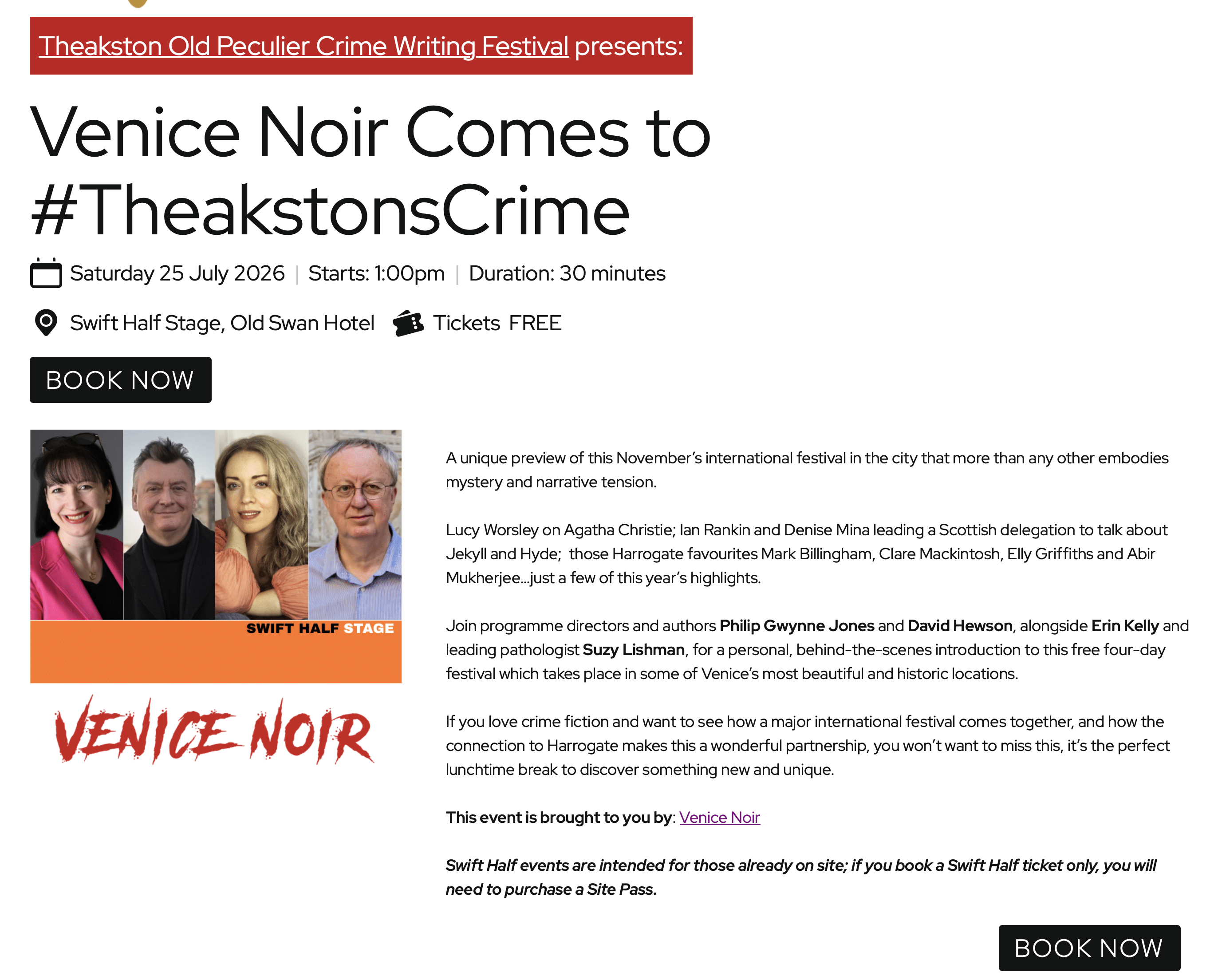
    We’ll be previewing the festival at a special event on the Swift Half Stage on Saturday July 25. I’ll be there along with my fellow co-founder Philip Gwynne Jones, Erin Kelly, one of our early author supporters, and Suzy Lishman, pathologist star of last year’s festival who’s returning this year to teach us all a bit more about death (and life) in her own uniquely entertaining way.

    Like Venice Noir’s main panels, the event is free, though you will need a pass to be in the festival itself of course. But we do advise booking since space is limits to 150 people. To do that just go here.

    I’m incredibly grateful to my volunteer colleagues, Philip, Silvia Bandolin, Marco Vidal and Gregory Dowling in Venice for their help in putting this together, and in the UK Patsy Irwin who has coordinated our media side. And, of course, the fine folk at Harrogate without whom we’d never have got off the ground in the first place.

    Avanti!